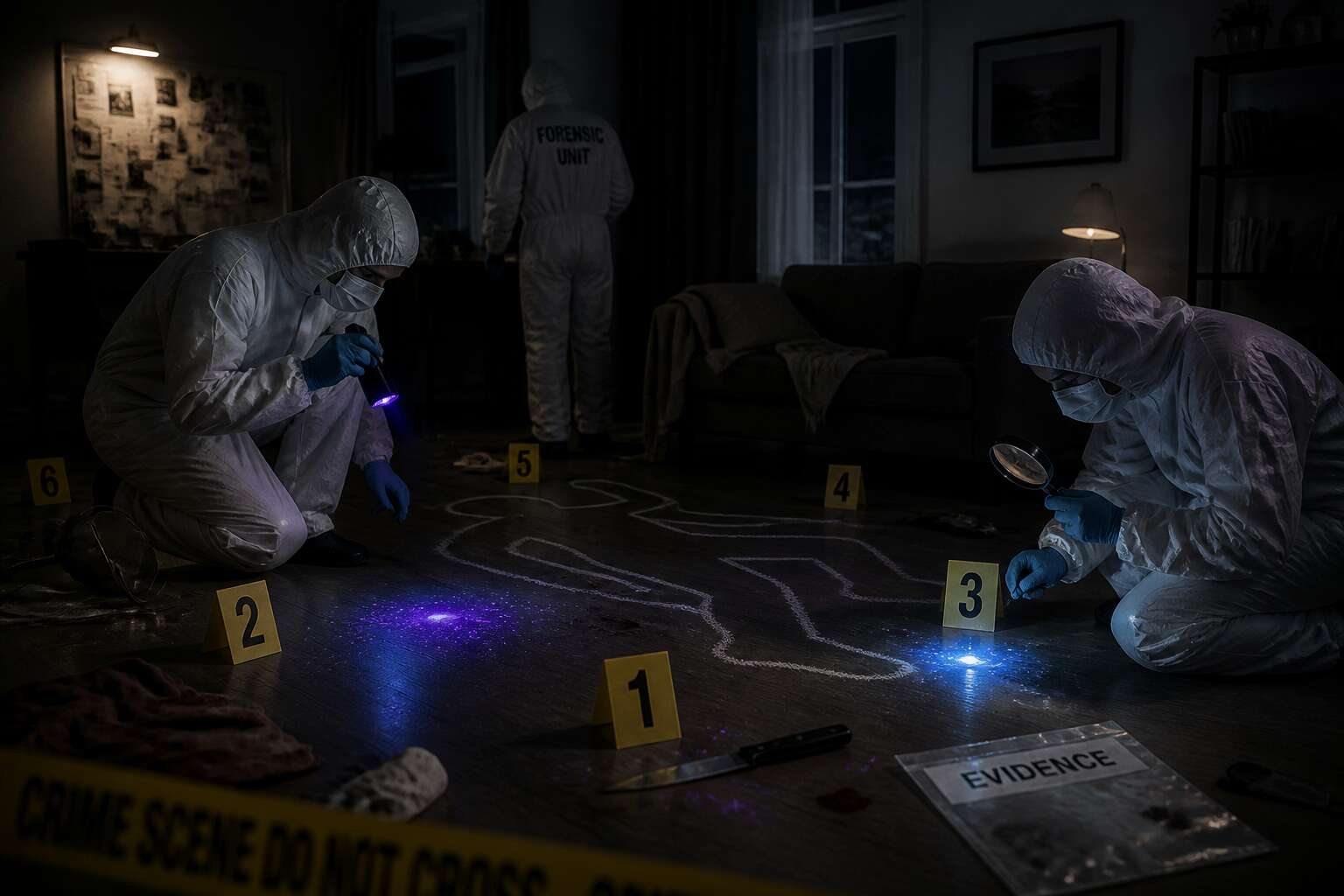
Why Players Love Forensic Mystery Games
Immersive Problem-Solving
I have watched players spend ten minutes staring at a blood spatter before touching evidence. They are not distracted. They are measuring. A crime scene investigation game rewards this patience. Every decision, from which tool to use to which suspect to press, carries weight.
The process matters more than the reveal. You lift a fingerprint. You run a chemical test. You compare a shoe print. Then you present a theory that holds up, or one that falls apart. The immersive problem-solving is why players return. It makes them responsible for the outcome. Here is what keeps them hooked:
- The small triumph of discovering a clue you almost missed
- The uncomfortable pleasure of proving your own theory wrong
- The final moment when all the evidence lines up
This involvement makes the game personal. The crime scene investigation game becomes a mental workout, and players choose it again and again!
Realistic Forensic Techniques
A crime scene investigation game depends on realistic forensic techniques. Players can spot a fake procedure from across the room. When the chemicals react correctly and the equipment behaves as expected, the game earns credibility.
That credibility matters. A player in Pretoria might work in law enforcement. Another in Cape Town might study forensic science. Both will notice when a game cuts corners. Neither will forgive a fingerprint that appears on a rough surface without powder. The details are the difference between a puzzle and a simulation.
The best moments are quiet ones:
- When a soil sample matches a garden in the suspect’s backyard
- When a tyre impression lines up with the evidence photo
- When a hair fibre analysis contradicts the testimony of a witness
Players finish a case in the crime scene investigation game and understand something real about forensic work. That understanding keeps them coming back for the next crime scene.
Narrative Depth and Character Development
In a crime scene investigation game, the story is the crime. Players return for the people behind the fingerprints. The narrative unfolds through interviews, alongside lab reports. Each suspect carries a history. A detective’s tired voice, a witness who hesitates, a confession that arrives too late. These moments give the mystery its weight.
Character development peaks in quiet exchanges. The game builds its cast with patience. That is what separates a puzzle from a story.
- The grieving widow who knows too much
- The neighbour with an alibi that does not hold
- The partner hiding a secret
Each role exists to test your empathy as much as your logic. I find myself caring about why someone broke, not how they did it. That depth anchors the entire crime scene investigation game, making every new case feel like meeting familiar frailties!
Intellectual Challenge and Critical Thinking
Every clue in a crime scene investigation game demands scrutiny. A single hair fiber can overturn an accusation. Players must reconcile conflicting timelines and test hypotheses against forensic evidence. This is far from passive entertainment; it demands sustained intellectual exertion.
The critical thinking required mirrors real detective work. You examine motives, weigh probabilities, and decide which witnesses deserve trust. That process of elimination becomes the core pleasure!
- Revisiting earlier locations with new knowledge
- Re-evaluating suspects when new evidence shifts the direction
- Connecting small anomalies into a coherent theory
Each decision carries consequence. When the final truth emerges, I understand its significance because I earned it through careful reasoning!
High Replayability and Multiple Endings
A crime scene investigation game rewards a second playthrough. Branching narratives mean one decision can lock away an entire line of inquiry. Players compare notes and discover that the ending they chased was only one of several. What pulls me back?
- A new witness perspective surfaces when I challenge a confession early.
- An overlooked stain in the lab reopens a closed case file.
- A dialogue choice alters who trusts me in the final act.
The replay value comes from writing that accounts for every choice. I have replayed scenes simply to observe how a minor character reacts differently. That is the quiet thrill. The game respects your time by making each run feel like a separate case.
Key Features To Look For In Investigation Titles
Evidence Collection Mechanics
Evidence collection in a crime scene investigation game determines the quality of the entire experience. The best titles treat every fibre and fingerprint as data with meaning. I have spent hours sifting through digital debris, and the difference lies in the mechanics.
Consider how the game handles trace evidence. Does it demand careful bagging and labelling, or does it simply highlight everything that glows? The latter kills the mystery.
- Chain of custody mechanics that punish sloppy handling
- Contamination risks when you disturb a scene
- Tools that require deliberate calibration before use
These features force a deliberate pace. They turn evidence collection into a ritual rather than a chore. A crime scene investigation game that respects the discipline of forensic work will keep you hunched over the screen long into the night.
Interrogation and Dialogue Systems
In a crime scene investigation game, interrogation scenes often make or break the illusion. I want to scrutinise micro-expressions across a pixelated face, not cycle through affinity meters. The best dialogue systems let you misread a suspect’s silence. They punish carelessness with closed doors.
What does a robust interrogation system actually demand? Let’s break it down.
- Voice stress analysis tools that force you to interpret, not auto-scan
- Dialogues where wrong assumptions burn bridges permanently
- Suspects who remember what you asked, and adjust their stories
Then there is the quiet art of asking nothing. A successful crime scene investigation game makes silence a weapon. When you pause to let a suspect stew, the conversation shifts. That interplay, the delicate push and pull between accusation and empathy, is what keeps me listening.
Open-World Versus Linear Storytelling
Open worlds promise freedom, but a crime scene investigation game often thrives on constraint. The question is whether sprawling maps dilute focus or deepen immersion. I have walked through sandbox cities where every alley hides a clue, yet the narrative stalls under the weight of choice. Linear storytelling builds momentum steadily. Each locked door matters because the path narrows.
Consider what structure serves the mystery:
- A curated environment that rewards patience over exploration.
- Time pressure that punishes wandering.
- A map that shrinks as you close in on the truth.
Open worlds work when they let you stumble into secrets. Linear stories work when they force you to confront them. The best crime scene investigation game knows when to open the world and when to close it.
Autopsy and Lab Analysis Mini-Games
Praise be to the game that treats an autopsy as a cognitive puzzle, not a grisly flourish. In a sharp crime scene investigation game, the Y-incision demands respect. You swab the wound track, weigh organs, and then answer the uncomfortable question: does this petechial haemorrhage come from manual strangulation or the side effects of a poorly tolerated sedative? That ambiguity is the essence.
Toxicology screens should preserve that ambiguity. Gas chromatograph peaks, enzyme panels, and the odd contaminant require careful cross-referencing with witness statements. Perhaps you need to test the victim’s morning tea dregs, then check for licit substances the pharmacist overlooked.
Then come the laboratory benches. A good crime scene investigation game might ask you to:
- compare bullet striations under a comparison microscope
- profile soil granules from a spade found in a Kloof garden
- match blood spatter ellipticity to the suspect’s footwear
Each exercise should complicate your assumptions without devolving into busywork.
Multiplayer and Co-op Modes
In a crime scene investigation game, multiplayer is a serious addition. It is a rigorous test of shared reasoning. The best co-op modes let one player manage the forensic log while another interrogates a suspect, with every action visible to the whole team.
Look for systems that encourage debate. Does the game allow split interpretations of the same bloodstain? Can your partner challenge your chain of custody? Some titles even force asynchronous evidence review:
- Coordinated evidence tagging that requires both players to agree.
- Live autopsy streaming where one player dissects and another cross-references toxicology.
- Shared case boards that update in real time, so no clue vanishes.
A crime scene investigation game with these features respects your time. It transforms a quiet puzzle into a collective effort, and that is rare.
Branching Outcomes and Player Agency
A crime scene investigation game holds its power in the moments when your decision changes everything. Choose to confront a suspect with a partial fingerprint, and the entire interview shifts. Decide to hold back a key piece of evidence, and the case files take a different turn. Branching outcomes reward this kind of agency.
The best titles track your choices and present consequences you did not predict. You might clear an innocent person by trusting a hunch, or send the wrong suspect to trial because you missed a contradiction. Evaluate these questions:
- Do your case file decisions alter the final verdict?
- Can you refuse a lead and still reach a resolution?
- Does the game acknowledge your earlier mistakes in later scenes?
In a crime scene investigation game, agency means accountability. A single choice can exonerate or condemn, and the game never lets you forget it.
Best Platforms And Genres For Sleuthing Adventures
PC and Console Classics
The PC has long been the home of the crime scene investigation game, where point-and-click adventures set the standard. Console classics later brought these mysteries to the living room, offering controller-friendly interfaces that changed how players interact with evidence. Handheld options also thrive, giving sleuths a portable way to examine clues.
Popular genres for this kind of play include:
– Traditional point-and-click adventures with inventory puzzles
– Visual novels that rely on dialogue and deduction
– Hidden object games for a lighter investigative pace
– First-person narrative mysteries that drop you into the scene
The platform shapes the experience. A crime scene investigation game on PC allows for complex interfaces and detailed graphics, while console versions streamline controls for accessibility. South African players can access these titles across major stores, with many classics remastered for modern systems and indie gems emerging regularly.
Mobile Hidden-Object Games
Nobody solves a murder in the time it takes to boil an egg, but mobile hidden-object games let you try. This streamlined take on the crime scene investigation game delivers the thrill of spotting a bloodstained cufflink without the paperwork. South African commuters can work through a mystery between Johannesburg and Pretoria, which is more than I can manage with a full coffee in hand.
Handheld sleuthing works because it removes the clutter. No inventory puzzles, no dialogue trees. Just your eyes and a suspiciously placed garden gnome.
Good mobile options include:
- Seek-and-find mysteries with forensic elements
- Casual titles that sync across devices
- Offline-friendly picks for load-shedding hours
The genre thrives on phones because loading times are short and attention spans shorter. A good crime scene investigation game on mobile respects your time, even if it does not respect your intelligence.
VR Detective Experiences
Virtual reality changes how you approach a crime scene investigation game. Instead of clicking through screens, you lean over a chalk outline and examine a bullet casing from every angle. The medium rewards physical presence. Your body becomes part of the investigation.
- Motion controls let you dust for prints with real hand movements
- Spatial audio hints at movement behind you
- Diegetic tools keep immersion intact
Platforms like the Meta Quest and PlayStation VR2 offer the strongest lineup. The best genres are narrative-driven mystery adventures and atmospheric exploration sims. These titles avoid combat and focus on observation, which suits the deliberate pace of detective work.
Board Game and Tabletop Adaptations
There is a particular pleasure in holding a piece of evidence in your hand, a tactile rush that no screen can replicate. Tabletop adaptations of the crime scene investigation game thrive on this sensation. You shuffle witness statements, lay out floor plans, and pass a bullet casing around the table. The investigation becomes a shared ritual, not a solitary clickfest.
For platforms, the best genres are cooperative deduction and social bluffing. Titles like Chronicles of Crime or Detective: A Modern Crime Board Game encourage players to scan evidence and debate theories aloud. The board game format slows time in a rewarding way.
- Search for games with modular boards and clue cards that reset for replayability.
- Look for expansions that add forensic mini-games or new case files.
These adaptations suit South African game nights where conversation and patience already matter. No digital interface stands between you and the truth.
Indie Gems and Underrated Hidden Treasures
Most crime scene investigation game fans are drawn to blockbusters. The shiny laboratories and famous detectives dominate the conversation. Yet the quiet corners of Steam and Itch.io hold true curiosities. These indie gems favour the amateur’s patience over the professional’s swagger. You might decode a landlady’s ledger or trace a boot print through a dusty Karoo farmyard.
Genres worth seeking out include interactive fiction, where every choice alters the record, and asymmetric deduction, where one player sees the scene while others interrogate them. Some titles rely entirely on text and sound. Others use real photographs as evidence.
What makes these underrated treasures special is their respect for player intelligence. They assume you will notice the inconsistency in a neighbour’s alibi.
A few favourites:
- Small, handcrafted cases with no filler
- Historical settings that teach as they entertain
- Experimental mechanics like fingerprinting through rhythm games
The result is a personal accolade. You finish with a story to tell, not a trophy to display. For the Joburg commuter or the Soutpansberg night owl, these hidden gems offer a crime scene investigation game that feels entirely your own.
Tips And Strategies For Aspiring Virtual Detectives
Observe Every Detail in the Environment
As a rookie in any crime scene investigation game, the environment holds the most reliable information. I often start by scanning for anomalies: a displaced rug, a smudged window, a broken latch. These minor details matter more than any dialogue option.
To sharpen your observational skills, adopt a systematic approach.
- Divide each room into quadrants and examine every surface twice.
- Adjust your brightness or gamma settings; hidden clues often vanish in shadows.
- Interact with objects that seem irrelevant, then rotate them for alternative angles.
- Listen for ambient sounds, such as a ticking clock or faint footsteps, which may signal interactive elements.
Patience turns a casual player into a thorough investigator within a crime scene investigation game. Every pixel on that screen deserves your attention! Teach your eyes to suspend judgment until you have catalogued the entire scene.
Manage Your Inventory and Evidence Log
A cluttered evidence log is a suspect’s greatest ally. In any crime scene investigation game, the difference between solving the case and spinning your wheels often comes down to inventory discipline. I treat every item like a sworn statement: it gets its own label and its own moment of scrutiny. Assign categories immediately. Blood samples belong with trace fibers, not beside a random key. Log each object’s origin, condition, and chain of custody. That last detail matters. When you return to the evidence screen hours later, you will know exactly why you picked up that crumpled receipt.
Keep your log fluid. Delete nothing. Update relevance as new facts surface. A single unlogged penny has broken more alibis than any confession.
Take Notes and Connect the Clues
The game will not connect clues for you. In any crime scene investigation game, notes are your external memory. I keep a separate page for names, dates, and contradictions. A suspect who lies about Tuesday may reappear hours later. That connection only surfaces if you wrote the first lie down.
Group notes by question, not by sequence. What did the killer need to know? Who had access? Which timeline conflicts? This approach turns scattered observations into a working theory. A single case can contain dozens of characters. Without notes, you lose the thread.
- Record exact quotes, not summaries.
- Link each clue to a question.
- Revisit notes after every new discovery.
Connecting clues means testing assumptions. Muddy boot prints mean nothing until you match them to the gardener’s shoes. In this genre, the link becomes the evidence.
Prioritize Timelines and Alibis
Time is the quiet conspirator in any crime scene investigation game. A suspect’s alibi only holds until you test it against a receipt, a phone ping, or a witness who saw them elsewhere. Prioritize timelines before you trust any confession. Map every hour aloud, then compare each character’s movements to the physical evidence you have already gathered.
In my experience, the most deceptive characters rarely refuse to talk. They talk too specifically. An alibi with excessive detail was likely rehearsed. For aspiring virtual detectives, I recommend this method:
- List all events that changed the crime scene.
- Assign a possible time to each event.
- Ask which suspect could not have been at the scene.
That final question will expose the lie! In the best crime scene investigation games, the timeline becomes the true antagonist.
Learn From Failed Choices and Wrong Accusations
Wrong accusations expose the flaws in your reasoning. In any crime scene investigation game, I have watched players chase a single suspect, ignore contradictory fingerprints, and force confessions onto innocent characters. The failure is not in guessing incorrectly. The failure is refusing to revisit the evidence when the story stops fitting.
When a choice collapses, ask what you missed. A torn sleeve, a locked drawer, a time stamp that shifts under pressure. Failed choices often reveal more than clean solves because they expose the gaps in your reasoning. In my playthroughs, the worst accusation taught me that certainty reduces observation.
- Return to the scene after each accusation.
- Compare the suspect’s motive to the physical proof.
- Accept that a wrong accusation is a clue in itself.
Every dead end in a crime scene investigation game is a correction. Read it before you choose again.
Use Logic and Deduction Beyond the Game’s Prompts
In a crime scene investigation game, the authored clues are only half the story. The other half lives in the spaces between them. A virtual detective who pauses to ask why a shadow falls left of the body, or why the victim’s phone is on silent, begins to think like the game designer. That mindset unlocks deductions no prompt will ever offer.
Here are three strategies I rely on when the interface goes quiet:
- Reconstruct the crime in reverse, from the final scene to the first movement.
- Test every character’s story against the physical layout of the map.
- Assume the game hides nothing, but presents everything in disguise.
These habits turn passive clicking into genuine analysis. In a crime scene investigation game, the best players treat every pixel as a sentence. Read the environment as a narrative. Then the next suspect’s alibi will break under its own weight.




0 Comments