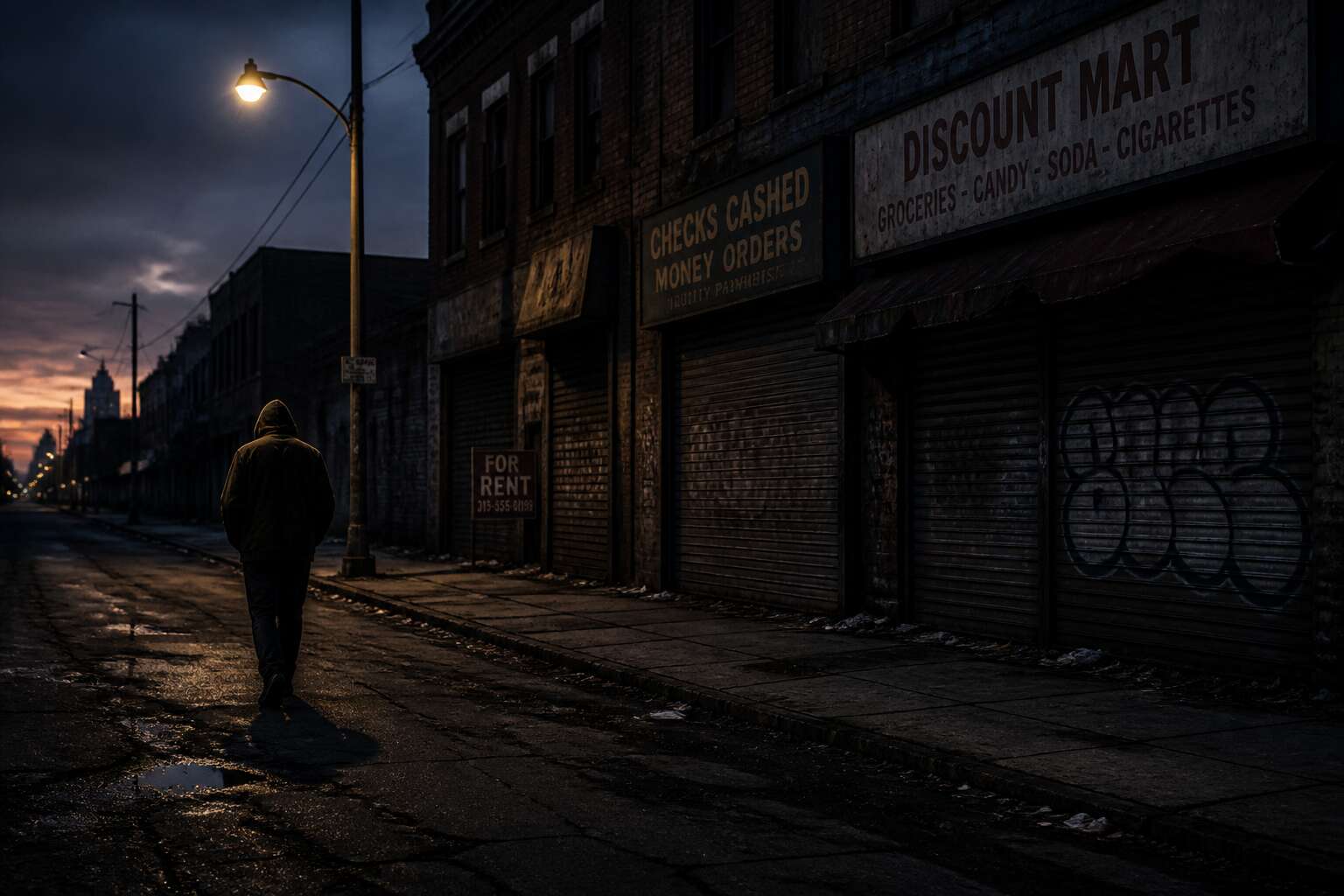
Economic Hardship and Its Link to Criminal Behavior
Unemployment Rates and Property-Related Offenses
In South Africa, the link between crime and poverty is not abstract. It is visible in the queues outside police stations, in the reports of stolen generators, in faces of people who have run out of options. Unemployment rates and property-related offenses move together with consistency.
Consider the mechanics. A person without income faces rent, food, and transport costs. Property crime becomes a rational response to immediate need. This is not an excuse for theft; it is an explanation of its prevalence. The common offenses are:
- Housebreaking in residential areas
- Theft of copper cable from public infrastructure
- Shoplifting from retail chains
- Vehicle theft for parts resale
These offenses track local job losses within months. This is the real face of crime and poverty. When survival itself is uncertain, the question of right and wrong takes on a different weight. The evidence points to empty shelves and unpaid accounts.
Income Inequality and Violent Crime Patterns
South Africa’s Gini coefficient, the highest in the world at 0.63, measures the distance between the boardroom and the shack. That distance has consequences. It registers in violent crime patterns that follow the contours of inequality with grim precision.
When opportunity is visibly hoarded, frustration turns outward. Relative deprivation, not absolute poverty, drives the aggression. A person who watches luxury vehicles pass their broken pavement experiences a specific torment. That torment demands release.
- Assaults tied to disputes over scarce resources
- Armed robberies targeting displays of wealth
- Gender-based violence worsened by economic dependency
Crime and poverty form one continuous conversation about who gets to live with dignity and who merely survives.
Financial Stress as a Driver of Petty Theft
When the electricity meter runs dry and the school shoes have holes, financial stress turns into a daily fight. I once saw a neighbor take a small bag of mealie meal. Her children were crying, and her purse held nothing. Petty theft rarely begins as a grand scheme. It begins with a due date that cannot be paid.
The stolen goods are humble.
- soap
- bread
- paraffin
These items signal desperation, not greed. Crime and poverty connect here in a simple equation. When survival costs more than a paycheck allows, the law becomes a secondary concern.
Housing Instability and Street-Level Criminal Activity
An eviction order does more than remove furniture. It removes the last barrier between a person and the street. Economic hardship and criminal behavior connect at this point. A man who loses his home loses his address and his credibility with an employer. Street-level criminal activity becomes the only remaining system for survival.
I have watched people sleeping under Johannesburg’s highway bridges, belongings in one bag. Housing instability does not create criminals; it creates circumstances where crime and poverty become indistinguishable. The desperation shows in the way someone studies a parked car or counts the minutes until a shop closes.
Consider what street-level activity involves here:
- scrap metal theft from construction sites, sold for a day’s rent
- informal car guarding that shifts into extortion
- breaking into abandoned properties for shelter
Each act is a calculation, not a choice. The law becomes distant when the pavement is the only home.
The Role of Welfare Support in Crime Mitigation
Economic hardship rarely announces itself. It arrives as a retrenched worker’s empty Friday, as a mother counting coins for a single loaf. When wages fail and savings vanish, the calculus of survival shifts. In South Africa, where unemployment exceeds 32%, the link between economic hardship and criminal behavior is not abstract. It is the queue at a social grant office, the hesitation before a shopkeeper’s till. Crime and poverty share a currency: scarcity.
Welfare support interrupts this exchange. The Child Support Grant and the Old Age Pension provide dependable income. Grant recipients report lower rates of property crime involvement. Welfare does not remove temptation. It restores a household’s ability to plan, and a predictable income changes behaviour.
- Cash transfers reduce food theft and shoplifting
- School feeding schemes lower juvenile crime
- Public works programs provide economic anchors
When the state withholds supports, informal economies emerge. Crime and poverty tighten their grip.
Resource Scarcity and Survival-Motivated Offenses
Scarcity changes decision-making before it changes hands. When a parent watches the last maize meal portion out, theft stops being a moral abstraction and becomes arithmetic. Survival-motivated offenses are rarely plotted in rand; they are plotted in missed meals, unpaid rent, and the weight of necessity.
In South Africa, crime and poverty are inseparable from this daily arithmetic. It is the taxi rank hustler, the security guard working double shifts, the hawker eyeing the spaza shop across the road. A resource-scarce brain prioritises immediate relief over long-term consequence. Shoplifting becomes a household budget strategy.
- Food items remain the most frequently stolen goods in convenience stores
- Non-perishables are targeted because they reduce the risk of spoilage
- Repeat offenders often cite the same reason: feeding dependants
I have seen this urgency in court waiting rooms and community halls. The state’s absence does not remove the hunger; it simply leaves desperation to its own devices.
Community Characteristics That Bridge Economic Deprivation and Public Safety
Neighborhood Disorganization and Social Control
In South African townships, the relationship between crime and poverty depends on local neighbourhood ties. A community where neighbours know each other by name can exert informal control that formal policing cannot replicate. Street committees, stokvels, and religious networks create routines of mutual oversight. Where these institutions erode, disorder becomes more common. Abandoned properties and unlit walkways signal that nobody is watching. Collective efficacy, the shared willingness to intervene, determines whether deprivation turns into danger. Consider what this looks like on the ground:
- Neighbours who report suspicious activity promptly
- Local leaders who mediate disputes before they escalate
- Residents who maintain visible presence after dark
These small acts of social control accumulate! They make crime less attractive without erasing poverty. The communities that manage this balance are not wealthier; they are simply more organised. In that organisation lies an answer to the cycle of crime and poverty.
Weak Social Cohesion in Under-Resourced Areas
In two Gauteng townships with near identical unemployment figures, one experiences robberies weekly while the other remains quiet. The relationship between crime and poverty is not fixed by income alone. It is mediated by social cohesion, the measure of reciprocal trust among residents. Where people lack shared histories, where migration is constant and rental tenure is uncertain, public spaces lose their guardianship. This atomisation creates opportunities that offenders recognise instantly.
Weak social cohesion appears in precise patterns. Investigators in under-resourced areas observe these recurring characteristics:
- High residential turnover, with new tenants unknown to long term residents
- Absence of organised activities that force repeated interaction
- Indifference to strangers moving through communal areas
These characteristics connect economic deprivation to public safety outcomes. They weaken the informal surveillance that formal policing depends on. Crime and poverty reinforce each other more aggressively where social cohesion is weak.
Lack of Opportunity Structures for Youth
When a teenager in Diepsloot has no sports ground, no library, and no apprenticeship pathway, the hours after school become a vacuum. That vacuum fills with something. Investigators in under-resourced areas consistently map the relationship between crime and poverty back to this missing scaffolding, the absence of opportunity structures for youth.
- No youth centres within walking distance of residential blocks
- No organised leagues, clubs, or mentorship programmes
- No school to work transition support or skills workshops
- No supervised spaces for study or recreation after dark
These gaps determine whether a young person sees a future in their community or a dead end. Where structured alternatives exist, even modest ones, they absorb attention and redirect energy. Crime and poverty thrive in the space where a teenager concludes that nothing legitimate is available to them.
Physical Decay and Perceptions of Lawlessness
On a street in Diepsloot or Khayelitsha, the built environment communicates neglect before any report is filed. Broken pavements and boarded windows are active signals, not passive scenery. When municipal upkeep stalls, the perception of lawlessness emerges before any crime occurs. That perception matters! It changes how residents move, how businesses invest and how young people assess their surroundings. This decay bridges economic deprivation and public safety, at the centre of the crime and poverty relationship.
- Streetlights dark for weeks
- Overgrown vacant lots
- Shops behind reinforced gates
Each visible failure lowers the cost of further neglect. A person who sees no one caring for the commons may conclude that disorder is tolerated. Economic hardship leaves the neighbourhood unable to maintain itself, and the resulting decay feeds the conditions that push crime and poverty deeper. We measure safety by arrest numbers, but residents measure it by what they see each morning.
Concentrated Disadvantage and Its Cumulative Effects
Poverty rarely arrives alone. Concentrated disadvantage operates as a compounding process. In a South African township or inner-city block, poverty clusters. A household with no steady income sits next to another in the same position. That cluster reduces options and social mobility. Each failed attempt makes the next attempt harder.
The cumulative effects shape how residents experience the crime and poverty link. They face a daily loop of scarcity, missed opportunities and weakened social ties. Consider the overlapping pressures:
- Multiple families sharing one small dwelling
- Few institutions offering after-school or job training
- High reliance on informal, unregulated income
These factors do not cause crime directly. They create an environment where crime and poverty reinforce each other. The concentration of disadvantage means no single intervention can break the cycle alone. It also shifts the neighbourhood’s reputation, deterring investment and reinforcing the conditions that breed crime.
The Cycle of Economic Struggle and Incarceration
Criminal Records and the Devastation of Future Employment
Every arrest leaves a permanent record. In South Africa, a criminal record outlives the sentence, turning a single mistake into a lifetime of exclusion. The link between crime and poverty becomes explicit here: the system punishes twice, first with incarceration, then with denial of legitimate work.
Employers routinely screen applicants. A record for petty theft or a property offense can disqualify a person from even a minimum wage job. Without income, the ex-offender returns to the same survival tactics that led to arrest, restarting the cycle.
- Arrest leads to conviction.
- Conviction creates a record.
- The record blocks employment.
- Employment loss forces illegal income.
Each step compounds the problem. The devastating reality is that a criminal record functions as a permanent barrier rather than a punishment, and the resulting poverty becomes the strongest predictor of reoffending.
Court Fines, Fees, and the Burden of Legal Debt
When a person cannot pay a fine, the state converts debt into days behind bars. In South Africa, unpaid court fees accumulate interest and penalties. A person who steals bread to eat leaves court owing more than the value of the bread. The magistrate offers an installment plan, but installment plans require income, and income requires employment. The link between crime and poverty becomes a record of compounding obligations.
The burden of legal debt creates a perverse incentive. Prison can feel like an escape from collectors. Behind bars, the debt does not disappear. It waits. It grows.
- Court fines consume wages before rent.
- Unpaid fees trigger additional warrants.
- Legal debt follows a person for decades.
Every payment to the state is money removed from food, transport, and housing. The cycle of economic struggle and incarceration tightens with each missed payment, deepening the entanglement of crime and poverty.
Family Disruption and Relapse into Financial Instability
When a parent goes to prison, the household accounts do not stop. Rent, school fees, and food arrears accumulate in their absence. I have seen grandmothers pawn their stoves to cover the shortfall. The disruption reorders the family entirely. Older siblings abandon homework to take up part-time jobs.
The consequences of this disruption:
- The primary caregiver loses their source of income support.
- Children are shuffled between relatives, losing stability.
- The family spends assets just to survive.
When the incarcerated person returns, they return to a broken set of arrangements. The home they left no longer exists. New debts were incurred to fill their gap. This relapse into financial instability deepens the connection between crime and poverty.
Recidivism Driven by Insufficient Reentry Support
Returning to a township after serving a sentence is not a fresh start. It is a return to the same economic pressures that fed the original offense. Without a valid ID, a bank account, or a place to sleep, the ex-offender quickly finds the door to formal work locked.
The lack of structured reentry support forces many back into coping with immediate survival needs. They face a choice between hunger and high-risk behavior. The cycle tightens when a parole officer’s sign-off depends on an address that no longer exists.
- No access to social grants because of missing documentation.
- Employers reject applications flagged with a criminal record.
- The cost of transport to a distant correctional centre for check-ins.
Insufficient reentry support does not sever the connection between crime and poverty. It reinforces it, and each failed reintegration becomes another trigger for recidivism.
Intergenerational Transmission of Economic and Judicial Involvement
A child in Makhaza does not need a criminology textbook to learn the link between crime and poverty. She watches her mother sell vegetables to pay for a father’s prison visits. The household income drops the day the sentence is passed. School fees become a luxury.
The mechanisms of transmission are concrete. Children of incarcerated parents fall behind at school, get expelled, and face police stops in their own neighbourhoods. The judicial system does not treat them as grieving children. It treats them as future offenders.
- A father’s arrest pushes a mother to work longer hours, leaving less supervision.
- The child’s identity is tied to the parent’s record.
- Exposure to correctional centres normalises incarceration as a life stage.
Each generation inherits the economic floor and the judicial suspicion of the last. This is how the bond between crime and poverty tightens across decades, becoming a family narrative rather than a personal failure.
Breaking the Link Through Prevention and Policy Reform
Community-Based Intervention and Mentorship Programs
South Africa’s cycle of crime and poverty demands more than reactive policing. Prevention strategies must address systemic failures before they manifest as offenses. Policy reform, such as redirecting funds from incarceration to early childhood development, disrupts the progression from deprivation to delinquency.
Community intervention programs offer another vital lever. Local mentorship initiatives connect at-risk youth with employed adults who model alternative paths. These relationships build the social capital that disorganized neighborhoods lack.
- Diverting first-time offenders from formal justice systems
- Funding after-school programmes in high-risk districts
- Training community members as conflict mediators
When prevention and mentorship converge, the link between crime and poverty weakens, offering residents a measurable chance at stability.
Education and Job Training as Antidotes to Lawbreaking
The link between crime and poverty often hardens in classrooms that fail to prepare. When learners leave school without marketable skills, the informal economy becomes the only visible employer. Policy reform that ties education funding to employment outcomes can shift this trajectory.
South Africa’s artisan shortage exposes this disconnect. Employers report thousands of unfilled technical positions, while young people sit idle. Redirecting a fraction of correctional spending into trade certification could produce electricians, plumbers, and welders who earn legally and contribute to municipal infrastructure.
Job training alone cannot erase systemic disadvantage, but it does give individuals leverage. Prevention becomes concrete when a young adult can point to a skill that pays a wage. That is how the cycle of crime and poverty finally weakens.
Policing Reform and the Restoration of Community Trust
In South Africa, low trust in law enforcement often cements the relationship between crime and poverty. When communities view police as arbitrary or corrupt, they stop reporting offenses, which leaves both victims and offenders stuck in a cycle of unaddressed harm. That silence does not reduce crime; it displaces it and deepens the economic damage that poor neighbourhoods already bear.
Prevention through policy reform means shifting resources from militarised responses to procedural justice. Officers who walk the same streets, know the same names, and respond to minor complaints with respect can rebuild legitimacy. That trust is not symbolic. It changes what people are willing to share with investigators and what witnesses are prepared to testify about.
- Independent oversight boards with real subpoena power
- Randomised audits of arrest and stop data to check bias
- Community feedback forums that directly influence precinct budgets
Restoring community trust also demands consequences for misconduct. In areas where police brutality is common, residents equate law enforcement with victimisation. That perception feeds crime and poverty, because economic opportunity relies on safe streets. Policy that ties promotion to positive community ratings is one practical lever. The goal is not softer policing. It is accountable policing that treats every resident as a constituent.
Expanding Social Safety Nets to Reduce Strain
Every month, a South African household on the edge makes a calculation. Rent, food, transport, school fees. When that calculation fails, pressure moves into stolen goods and crimes of desperation. This is the quiet engine of crime and poverty, and policy can slow it.
Expanding social safety nets is a structural intervention. Cash transfers, food vouchers, and subsidised transport reduce strain that pushes people toward offenses. A family that meets basic needs has less reason to accept stolen goods or survival theft.
I have seen the cycle in community meetings. A lost grant application, a delayed payout, a rent spike, and the grocery money vanishes. The state can break that sequence. Practical levers include:
- Automatic enrollment for qualifying households
- Direct bank payments to reduce corruption
- Indexed benefits that track food prices
These measures lower the financial pressure that fuels criminal activity. Reliable safety nets absorb shocks before they become offenses. Prevention means keeping poverty from converting into crime.
Urban Development and Economic Diversification Initiatives
One factory closure can reshape a town’s entire criminal landscape. The geography of opportunity in South African cities remains stubbornly uneven. Townships sit far from employment nodes, and single-industry towns collapse when one sector falters. That spatial mismatch feeds crime and poverty.
Urban development and economic diversification are policy reforms that address root conditions. When residential areas include commercial zones, when transport links connect workers to multiple industrial hubs, pressure on informal economies drops. Diversification means no single factory closure can hollow out a neighbourhood’s legal options!
Practical reform levers include:
- Mixed-use zoning to shorten commutes and increase foot traffic
- Industry incentives that recruit varied employers to under-served regions
- Public investment in digital infrastructure for remote work
These measures reshape the physical and economic landscape. Crime and poverty thrive in single-sector economies and isolated neighbourhoods.
Restorative Justice and Victim-Centered Alternatives
Restorative justice breaks the circuit between crime and poverty by addressing harm rather than merely punishing the offender. In South African communities where survival drives lawbreaking, a formal court process often deepens the very exclusion that produced the offense. Victim-centered alternatives, by contrast, give the harmed party real agency. They decide what repair looks like, whether that means financial restitution, community service, or a structured apology.
Prevention through policy reform redirects resources toward early intervention. Instead of waiting for an arrest, municipalities can fund neighbourhood-based restorative circles. These require:
- Facilitators trained in trauma-informed dialogue
- Referral pathways from schools and clinics
- Oversight to ensure voluntary participation
When these mechanisms exist, crime and poverty lose their symbiotic grip. The offender remains accountable, but also remains employable. The victim receives acknowledgment, not just a case number. That is how a community breaks the cycle.
Shifting Public Perceptions and Media Portrayals
Stigmatization of Low-Income Neighborhoods
News broadcasts rarely show morning queues at community clinics or traders setting up stalls. They show the aftermath of a shooting. This is how many South Africans see low-income neighborhoods. Media Monitoring Africa has documented that coverage of poor areas leans heavily on crime reporting, while affluent suburbs receive softer feature treatment.
This imbalance does real damage. It teaches the public to equate crime and poverty as one story. Poverty becomes a character flaw, not a condition. Residents of Delft or Diepsloot become suspects or victims in the public imagination. Their voices disappear.
The stigmatization extends beyond perception. It shows up in daily decisions:
- Landlords screen tenants based on postal codes.
- Employers hesitate to call back applicants from certain areas.
- Insurance premiums climb for residents of specific suburbs.
The media rarely covers these consequences, but they follow every broadcast. I see this in my own community. A single headline can overshadow years of neighborly work!
Moral Panic versus Empirical Evidence
Moral panic often drives the link between crime and poverty in South African media. A single incident in Khayelitsha can become a week of headlines while empirical evidence disappears from the coverage. The numbers rarely change. Statistics reveal a nuanced picture, yet fear grows with each broadcast.
Empirical evidence offers a different view. The connection is genuine and structural. It emerges from material conditions, not character.
Consider what shifts when coverage changes:
- Police statistics receive context instead of sensationalism.
- Community voices appear alongside official statements.
- Reporting tracks trends over months, not hours.
Perception is not fixed. It moves with what audiences consume. Once editors treat the two as separate but connected issues, the public can respond with evidence instead of alarm.
The Intersection of Race, Class, and Crime Reporting
South African media frames a suspect according to their suburb. A white-collar accused in Sandton receives a financial background profile. A young Black man in a Cape Flats township becomes a data point about crime and poverty. The intersection of race, class, and crime reporting shapes public fear before evidence emerges.
Shifting perceptions demands acknowledging this asymmetry. I have watched reporting change when journalists:
- Lead with the socioeconomic context of an offense
- Cite zoning laws alongside police statements
- Examine how the same act is labelled differently across postal codes
Class determines whether an offense is called a mistake or a crime. Race determines whether a suspect is a victim of circumstance or a threat. These two factors work together, and recognising them changes how the public reads every headline.
Wealth Biases in Legal Proceedings and Bail Decisions
Bail decisions shape public perception before evidence is heard. The accused who writes a cheque walks into sunlight. The accused who cannot stares at concrete walls. Wealth biases in legal proceedings are visible through every court report:
- Access to private counsel changes the framing of a defense.
- Ability to pay bail keeps a suspect employed and visible in their community.
- Property ownership offers a credible claim of roots, reducing perceived flight risk.
Media portrayals amplify this gap. The affluent suspect receives sympathetic coverage. The indigent suspect becomes a symbol of crime and poverty. When crime and poverty are conflated in coverage, bail becomes a public performance. One suspect’s story is told through family testimonials and career highlights. The other through prior arrests and neighbourhood reputation. These differences reinforce an assumption that justice is bought.
Resilience-Focused Narratives from Affected Communities
The stories told about South African neighbourhoods often come from outsiders with cameras and verdicts already formed. But inside communities where crime and poverty are daily companions, residents are rewriting the script. They speak of the mechanic who mentors teenagers between engine repairs, the grandmother who runs a homework circle on her stoep, the shopkeeper who gives credit to families in crisis. These resilience-focused narratives are not denial of hardship. They are evidence of resourcefulness.
Media portrayals have long favoured fear-based angles. A growing countercurrent now centres community knowledge:
– Local radio shows amplify resident voices over police statements
– Street committees share prevention strategies that work
– Youth groups document their own experiences online
Shifting public perceptions requires trusting those who live the reality. Their testimony is the most accurate map of what interventions might actually succeed.




0 Comments